
Biryani: A Dish Nobody Can Quite Agree On
Ask an Indian family where biryani really comes from and watch the table split into factions. Everyone has a version, everyone is certain, and almost nobody agrees.

It is one of the reasons biryani has such a pull on people, and it is exactly why it is one of the most-ordered dishes on the Madras Cafe menu here in Glasgow. It is usually the first thing new guests ask about once they sit down, and it is worth knowing the story behind it, because it is a genuinely good one. It involves emperors, exiled princes, a pet tiger, and a piece of detective work that quietly demolishes one of the most-told food legends in India.
The story everyone tells
The most popular version goes like this. Sometime in the 1600s, the Mughal empress Mumtaz Mahal, the woman the Taj Mahal was built for, visited an army barracks and found the soldiers thin and undernourished. She asked the royal kitchens to invent something that combined meat and rice into one properly filling meal, and biryani was born.
It is a lovely story. It also cannot really be true, and most serious food historians treat it as folklore rather than fact. Which raises the obvious question: if the empress did not invent it, who did?
The honest answer is nobody knows, and that is actually the more interesting part.
Older than the empire that gets the credit
Spiced rice and meat dishes were already being eaten in parts of India well before the Mughals ever arrived. There is a Tamil dish called Oon Soru, made with rice, meat and warming spices, that shows up in writing as far back as the 2nd century, roughly 1,300 years before Mumtaz Mahal was born. There are also accounts from Arab and Persian travellers describing elaborate spiced rice at Indian royal courts generations before the Mughals took power.
What most historians now think happened is much less tidy than one royal invention. Traders sailing between Persia and the western coast of India, particularly around what is now Kerala and the Deccan, brought over a Persian-style rice dish. Indian cooks took it, added their own spices, swapped ingredients depending on what was local, and kept adjusting it over the following centuries. The Mughals, who arrived later, did not invent the dish so much as give it a very large royal marketing budget. Their kitchens turned it into something genuinely spectacular, with vast quantities of saffron, dried fruit and ghee, and that is probably why the whole thing got attributed to them in the first place. It is easier to remember an empress than a few centuries of ordinary trade.
The best story in biryani history
If there is one story that captures how muddled biryani's history really is, it is what happened in Kolkata.
The tale usually told is a sad one. In 1856, the British exiled Wajid Ali Shah, the last king of the Lucknow region, to Kolkata. He brought his royal cooks with him but had, so the story goes, fallen on hard times, and could no longer afford enough meat for a proper biryani. So his chefs padded the dish out with potato instead, and that is supposedly why Kolkata biryani, uniquely among Indian biryanis, always includes a large, tender potato.
It is a touching image of a fallen king making do. There is just one problem with it. Historians looking into old records found that the exiled king was, at the exact same time, spending a small fortune keeping a private zoo, tigers and leopards included, and feeding them meat every single day. He was not remotely short of money. On top of that, the potato itself had not even reached that part of India yet. Records show it did not arrive in the region until 1879, which is eight years after the king had died. He could not have added an ingredient that had not turned up yet.
So who actually put the potato in Kolkata's biryani? The most likely answer, according to that same research, is that it happened decades later, sometime after the 1950s, once biryani had become popular enough with ordinary people that a potato was simply a cheap and clever way to stretch the meat further for a big family meal. Nobody remembers that version, because a struggling exiled king is a far better story than a thrifty home cook. But it is a good reminder that a lot of what gets repeated as food history is really just the nicest available story winning out over the true one.
A dish that keeps changing its mind
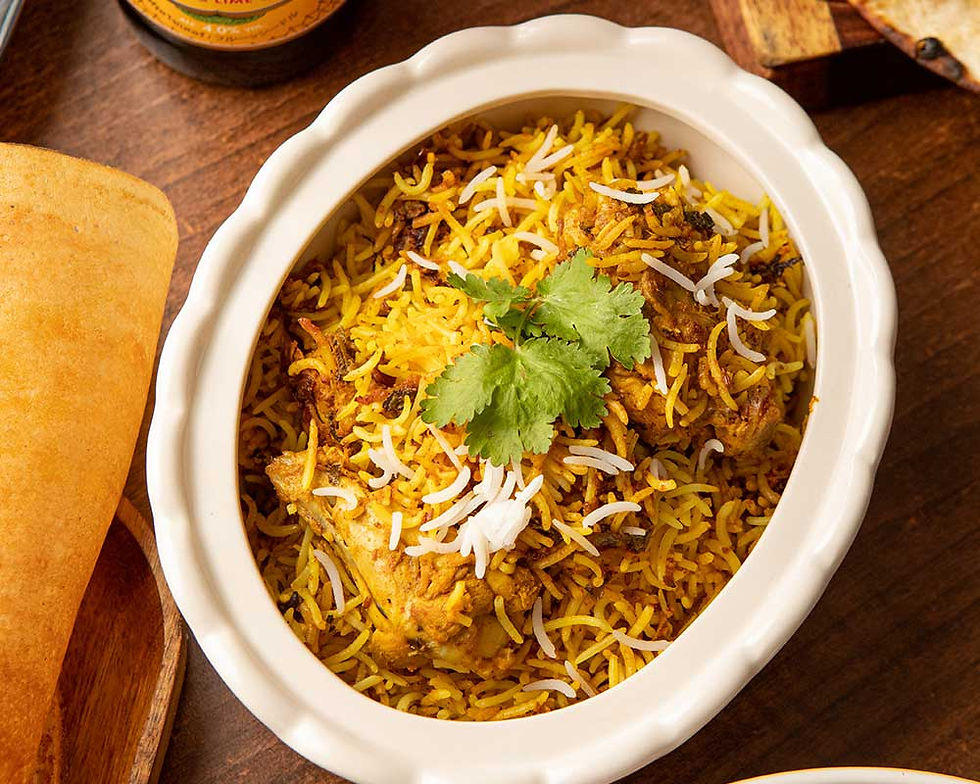
Once biryani had properly taken hold, nearly every region that adopted it changed something about it and then refused to change it back. Hyderabad, in the south, became so associated with the dish that its version is now considered close to the definitive one, richly spiced and cooked with the meat and rice sealed together so the flavours have nowhere to go but into each other. Head north to Lucknow and the same basic idea comes out gentler and softer, built on a long-simmered stock rather than heavy spicing. Travel toward the coast and it changes again, leaning on coconut and lighter, shorter grains of rice instead of the classic long basmati.
None of these is the "real" biryani and the others knockoffs. They are simply what happens when one good idea spends a few hundred years being cooked by different people with different ingredients on hand.
The extremes
Biryani has also, unsurprisingly, tempted a few people into doing something completely over the top with it. In 2008, a team of sixty chefs working for an Indian food company cooked a single batch of biryani weighing over fourteen tonnes, a record still recognised by Guinness World Records. That is roughly the weight of two double-decker buses, made of rice.
At the more everyday end, biryani's popularity in India today barely needs proving. According to the food delivery platform Swiggy, biryani was the single most-ordered dish in the country for the tenth year running in 2025, with 93 million orders placed on the app alone that year. Whatever else remains disputed about its history, nobody is arguing about whether people actually want to eat it.
A few common questions
Is biryani Indian or Pakistani?
Both, really. Biryani is eaten and claimed with equal pride across India, Pakistan and Bangladesh, and each country has its own distinct regional styles. It is a dish that belongs to the whole subcontinent rather than one country alone.
What is the difference between biryani and pulao?
Pulao is rice, meat or vegetables, and spices, all cooked together in one pot from the start. Biryani is usually more involved, with the meat and rice at least partly cooked separately before being layered together and sealed to finish cooking in each other's steam. That extra step is what gives proper biryani its distinct pockets of flavour rather than one even taste throughout.
Is biryani very spicy?
It depends entirely on the style. Some regional versions, particularly further south, are built to be fiery. Others, like the Lucknow style mentioned above, are deliberately gentle and fragrant rather than hot. Most Indian restaurants, Madras Cafe included, can adjust the heat to suit.
Can biryani be vegetarian?
Yes. Vegetable biryani swaps the meat for a mix of vegetables and sometimes paneer, but keeps the same layered rice technique, so it is every bit as involved to cook properly.
Where can I get good biryani in Glasgow?
There are a fair few places across the city worth trying. If you want to taste what all the history above actually amounts to, Madras Cafe's biryani are on the menu daily on Stockwell Street, and it is an easy spot to grab a proper plate and judge it for yourself.
Where you can get a great Biryani in Glasgow
Given how contested biryani's own story is, Madras Cafe has never tried to claim ownership of one single "correct" version. The chicken and beef biryani on the menu are made the way biryani has always evolved, taking the technique seriously and building something that works for the kitchen and the guests in front of it, rather than performing authenticity for its own sake.
If you fancy settling the argument for yourself rather than trusting any of the five different versions you will hear at any given dinner table in Glasgow, the simplest way is still the original one. Order a plate and decide. You can book a table here.